- Journalism isn't just a career, its a way of life.
- Many publications have gone online ONLY since 2008.
- 21st Century Journalists Must Be Able To...
- Write news and feature copy for print and web.
- Visualize stories for magazine and web formats.
- Write a blog.
- Sub-edit news and features for print and web.
- Record an interview with audio and/or video.
- Record a stand-up piece to camera and edit it for publication.
- Use a content management system.
- Be active in their online community.
- Be able to understand and implement SEO (search engine optimization) tags.
- Be flexible with writing structures.
- Work experience is crucial, it shows career commitment.
- Your schooling must be dedicated to practical journalism.
Wednesday, June 15, 2011
Textbook Notes: Page 475-81


Textbook Notes: Page 203-210
- Developing Interview Skills
- TIPS
- Avoid questions that produce yes & no answers.
- Ask open-ended questions that will yield a clear answer.
- LISTEN
- Think about what the answers mean.
- Think about what the reader wants to know.
- Check spelling of names and places.
- Determine whether a photo is needed.
- Make sure the interviewee has your contact information and you have their's.
- Think of taking video or audio recording to use for the online article.
How to Write Headlines: Video Notes from Website
- Writing for the web yeilds a constand deadline.
- Headlines for web
- write heads, thinking about the key words people will search for on a search engine site.
- Keep key words close to the beginning of the headline.
- Use place names and peoples names.
- Needs to make clear the subject of the story.
- Readers want to know if the story applies to them before they read it.
- Keep headlines short.
Tuesday, June 14, 2011
Interviewing Notes: Pages 207-8, 212-13,321-25
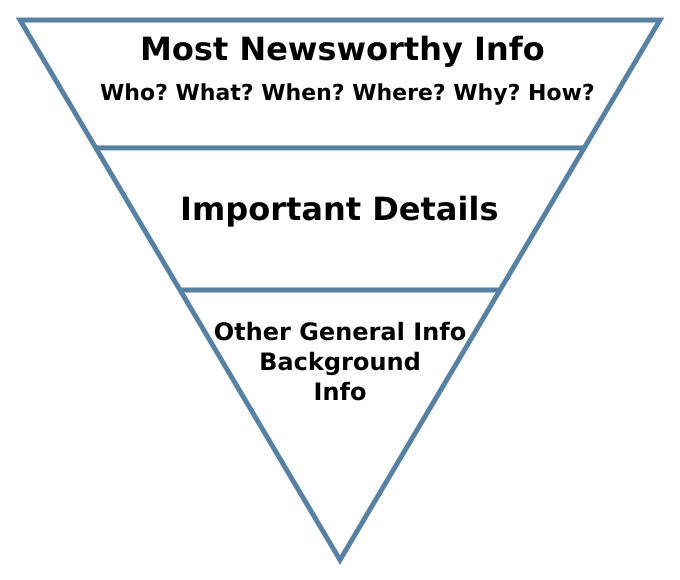
Story Structure:Inverted Pyramid
- Begin with simple questions.
- Confirming basic details.
- When writing notes in an interview be sure to periodically look at the interviewee and nod to show them you are attentive.
- Difficult Interviews
- How to deal with uncooperative interviewees when the say...
- "This must ve off the record"
- You don't have to go off the record retrospectively.
- Ask them why the want to be off the record.
- If the give good material, off the record, ask if some of the information an be put on record.
- If NOT ask if it cam be attributed to a source (company, organization, etc).
- "Promise me you wond report this"
- Be reluctant to make any promise.
- Tell them that if you do report material of their concern, it will be from another source.
- "Can I see you story before it is published?"
- BAD IDEA!
- Sometimes it is necessary to agree to som kind of disclosure of the story before it is published.
- It MUST be a signed contract.
- Otherwise be very reluctant to show the interviewee a copy before it is published.
- If they insist, let them ONLY verify their quotes, don't show them the full article.
- Interviewing for Features
- A "life in the day"
- The person is interviewed about their day, in describing if they reveal a good deal about themselves and their life.
- The day's events determine the story structure.
- Structure A General Feature
- Refer to the inverted pyramid as a guide.
- With a feature you can start your story at any point (sensably).
- Your inro's job in this case is to hook the reader.
- Ask yourself...
- Whats the most interesting thing?
- Whats the one thing you remember from the interview?
- What is the key point?
Textbook 3A3 & 3A4: Notes
- 3A3
- Shooting Pictures
- a camera phone will get the job done.
- shooting many pictures of an event allows you to tell the story through images.
- Lighting: 3 Types
- Natural - ambient light
- Flash as a main source of light
- Ambient and flash together
- The subjects face should be near the top of the photo when taking a face shot.
- Keep your photos simple
- Be conscious of what is in the background of the photos you take.
- Rule of Thirds
- Divide an image into 9 equal parts by 2 equally spaced horizontal and vertical lines.
- The subject of the photo should sit at the intersection of 2 of the lines.
- 3A4
- Editing Pictures
- edit a copy of each photo, not the original.
- crop the photos (ethically)
- edit out wasted space
- optimize the image if posting it online.
Verification & Data Visualization
- Story Verification
- Objectivity involves verifying facts.
- Techniques of Verification
- Edit with skepticism (aka Prosecutorial Editing).
- Adjudicating (act as a judge) a story line by line.
- When Editing, Ask Questions
- How do we know this?
- Why would a reader believe this?
- What is the assertion behind the sentence?
- Tip: Editor and reporter sit side by side to edit the story.
- Keep an Accuracy Check List
- Ask More Questions
- Is the lead of the story sufficiently supported?
- Is the context of the story complete?
- Are all stakeholders in the story identified?
- Have other sides of this issue been contacted?
- Does the story pick sides or make subtle value judgements?
- REMEMBER: When a journalist has an agenda going into an interview the story them becomes propaganda.
- Final Questions To Ask
- Have you attributed (given credit to) all of these facts in the story?
- Do the facts back you up your story?
- Did you double check the quotes and make sure they are in proper context?
- Data Visualization / Information Graphics
- Information graphic is a set of information organized in a visual manner.
- Information design makes complex information understandable to more people than traditional text.
Subscribe to:
Posts (Atom)