- Journalism isn't just a career, its a way of life.
- Many publications have gone online ONLY since 2008.
- 21st Century Journalists Must Be Able To...
- Write news and feature copy for print and web.
- Visualize stories for magazine and web formats.
- Write a blog.
- Sub-edit news and features for print and web.
- Record an interview with audio and/or video.
- Record a stand-up piece to camera and edit it for publication.
- Use a content management system.
- Be active in their online community.
- Be able to understand and implement SEO (search engine optimization) tags.
- Be flexible with writing structures.
- Work experience is crucial, it shows career commitment.
- Your schooling must be dedicated to practical journalism.
Wednesday, June 15, 2011
Textbook Notes: Page 475-81


Textbook Notes: Page 203-210
- Developing Interview Skills
- TIPS
- Avoid questions that produce yes & no answers.
- Ask open-ended questions that will yield a clear answer.
- LISTEN
- Think about what the answers mean.
- Think about what the reader wants to know.
- Check spelling of names and places.
- Determine whether a photo is needed.
- Make sure the interviewee has your contact information and you have their's.
- Think of taking video or audio recording to use for the online article.
How to Write Headlines: Video Notes from Website
- Writing for the web yeilds a constand deadline.
- Headlines for web
- write heads, thinking about the key words people will search for on a search engine site.
- Keep key words close to the beginning of the headline.
- Use place names and peoples names.
- Needs to make clear the subject of the story.
- Readers want to know if the story applies to them before they read it.
- Keep headlines short.
Tuesday, June 14, 2011
Interviewing Notes: Pages 207-8, 212-13,321-25
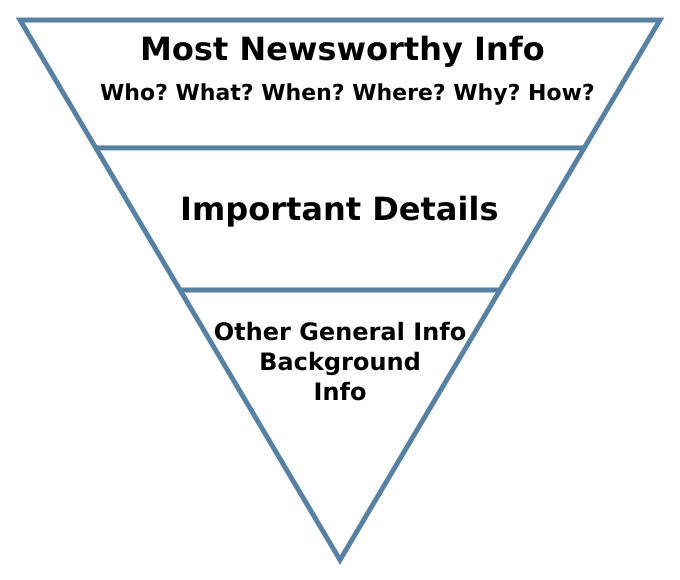
Story Structure:Inverted Pyramid
- Begin with simple questions.
- Confirming basic details.
- When writing notes in an interview be sure to periodically look at the interviewee and nod to show them you are attentive.
- Difficult Interviews
- How to deal with uncooperative interviewees when the say...
- "This must ve off the record"
- You don't have to go off the record retrospectively.
- Ask them why the want to be off the record.
- If the give good material, off the record, ask if some of the information an be put on record.
- If NOT ask if it cam be attributed to a source (company, organization, etc).
- "Promise me you wond report this"
- Be reluctant to make any promise.
- Tell them that if you do report material of their concern, it will be from another source.
- "Can I see you story before it is published?"
- BAD IDEA!
- Sometimes it is necessary to agree to som kind of disclosure of the story before it is published.
- It MUST be a signed contract.
- Otherwise be very reluctant to show the interviewee a copy before it is published.
- If they insist, let them ONLY verify their quotes, don't show them the full article.
- Interviewing for Features
- A "life in the day"
- The person is interviewed about their day, in describing if they reveal a good deal about themselves and their life.
- The day's events determine the story structure.
- Structure A General Feature
- Refer to the inverted pyramid as a guide.
- With a feature you can start your story at any point (sensably).
- Your inro's job in this case is to hook the reader.
- Ask yourself...
- Whats the most interesting thing?
- Whats the one thing you remember from the interview?
- What is the key point?
Textbook 3A3 & 3A4: Notes
- 3A3
- Shooting Pictures
- a camera phone will get the job done.
- shooting many pictures of an event allows you to tell the story through images.
- Lighting: 3 Types
- Natural - ambient light
- Flash as a main source of light
- Ambient and flash together
- The subjects face should be near the top of the photo when taking a face shot.
- Keep your photos simple
- Be conscious of what is in the background of the photos you take.
- Rule of Thirds
- Divide an image into 9 equal parts by 2 equally spaced horizontal and vertical lines.
- The subject of the photo should sit at the intersection of 2 of the lines.
- 3A4
- Editing Pictures
- edit a copy of each photo, not the original.
- crop the photos (ethically)
- edit out wasted space
- optimize the image if posting it online.
Verification & Data Visualization
- Story Verification
- Objectivity involves verifying facts.
- Techniques of Verification
- Edit with skepticism (aka Prosecutorial Editing).
- Adjudicating (act as a judge) a story line by line.
- When Editing, Ask Questions
- How do we know this?
- Why would a reader believe this?
- What is the assertion behind the sentence?
- Tip: Editor and reporter sit side by side to edit the story.
- Keep an Accuracy Check List
- Ask More Questions
- Is the lead of the story sufficiently supported?
- Is the context of the story complete?
- Are all stakeholders in the story identified?
- Have other sides of this issue been contacted?
- Does the story pick sides or make subtle value judgements?
- REMEMBER: When a journalist has an agenda going into an interview the story them becomes propaganda.
- Final Questions To Ask
- Have you attributed (given credit to) all of these facts in the story?
- Do the facts back you up your story?
- Did you double check the quotes and make sure they are in proper context?
- Data Visualization / Information Graphics
- Information graphic is a set of information organized in a visual manner.
- Information design makes complex information understandable to more people than traditional text.
Dave Jenett Interview Questions
Vince: Some Questions
- Terry mentioned you started a business in 1954. What was the business you started?
- For what reason did you specifically go into that industry?
- I hear you have worked with many movie stars. What did you enjoy about working with your favorite actor/actress?
- What personal values do you live by?
- What is the benefit of running your company with strong ethics?
- What services did you offer to the actors and actresses you worked with?
- What did you work on with Milton Berle?
- What did you enjoy about working in your industry/trade?
- When you were faced with a “challenging” client, how did you approach the situation?
- Which personal values are most important to you?
- What advice would you give someone about to graduate and enter the work force?
Jason: Some Questions
- Why did you decide to open your business?
- How much has the industry changed since you opened your business in 1954?
- What specific services does your business offer?
- How has your business grown since then?
- How would you describe the entertainment scene in 1954?
- What are some of the most memorable experiences you’ve countered in your career?
Kyle Gutman: Questions
1. What is the essence of your work, your business, your life?
2. Is there a certain place that is dear to you and why?
3. At what time did you know where your life was going?
4. Has anything from your past reinforced how you feel about what you do?enforcedei

Interview Thoughts: Operation Project Hope
At a late night meeting I sat down and interviewed Greg Baarson and Martha Shickley about their involvement with the community project. We talked about many aspects of the project from disaster preparedness and campus beautification, to teacher and student morale. I had a series of questions ready to ask, but maintained an organic method of asking one question and saw where it took us. I managed to keep the interviewees on topic when they strayed, a few times. For my next interview I will be sure to ask more open-ended questions and take photos of the people I interview for the slideshow of pictures. Overall I am satisfied with the interview i conducted.
Operation Project Hope In South Central
Written By: Vince Baarson
Operation Project Hope, a beautification of Hooper Elementary in South Central, CA commenced on June 4th, 2011.
Project Hope’s mission for the Hooper Elementary project was to boost student and teacher moral by way of campus beautification and personal growth seminar. Affirmations, “I am responsible”, “I am worthy”, “I am confidant”, and more were painted on the interior walls of the school by the volunteers. The campus was cleaned and landscaped, the kitchen sanitized and repainted, and the schools emergency water supply replenished. More than three hundred volunteers, students and their families, completed all of this and more in eight hours time.
Greg Baarson, logistics coordinator exclaims, “We really wanted to include the families in this project.”
Hooper Elementary is located in South Central Los Angeles. One hundred percent of the students qualify for the state’s lunch program, the families’ average annual income is fifteen-thousand-dollars, and thirty-three of the families are homeless.
Martha Shickley, coordinator of the clothing and food drive explains, “It’s a pretty daunting world right now and it makes people feel good that they can do something that will make a difference in a community and this project WILL make a difference.”
The hope of this project is it will benefit the community from the standpoint of involving the parents and students of the school will see there are people in Los Angeles who care about them. It will give them a sense of pride and inspire them to continue the rejuvenating of their community. Also by educating the families on the health and supplemental services that are available for them such as the food bank and health care options.
Many of Hooper’s teachers received tickets to PSI Seminars Basic class to practice personal growth and to realize unity of the staff. PSI’s philosophy is “World peace one mind at a time.” It is a growing movement of like-minded individuals who unconditionally improve the lives of all people.
Greg states, “This project is really great because it is a demonstration of how people, like minded people, can come together and through collective efforts do some good. With out any preconditions.
One hundred thirty gallons of paint and sealer were donated in kind by many hardware stores, hundreds of plants by the green house at Sylmar High School, and tools lent by the Los Angeles Unified School District. This along with hundreds of volunteers transformed Hooper Elementary, which has only ONE full-time janitor to clean up after twelve hundred students.
Progress
Food and an overwhelming amount of clothing flooded in that day. Many asked to get involved wrote checks, versus volunteering their time, to the cause in which these families will see one hundred percent of the donated funds. Hooper elementary students arrived to an atmosphere of inspiration and beauty on Monday morning.
Operation project hope is just one of many events occurring throughout the world organized by PSI Seminar graduates.
Learn More About PSI Seminars
Dave Jenett: The Real Mr. Fix It
By: Vince Baarson, Kyle Gutman & Jenhnsen Lopez
Dave Jenett has lived an accomplished and fulfilling life, including a taste of stardom as the television personality Mr. Fix It.
He appeared hundreds of times on morning shows such as “Alive and Well” with host Joanne Carson and has even been a guest on the “Late Show” with Dave Letterman. In thirty years of working repair jobs for celebrities, Don Rickles, Raquel Welch and Linda Evans, to name a few, he has remained a humble, honest and joyful man.
Born in 1926 he grew up in Newark, New Jersey. As a shy child he excelled in mechanics and attended a boy’s technical high school in place of a traditional institution. His mother instilled in him the importance of honesty and respect.
Jokingly Dave exclaims, “My mother gave me a curse (honesty and truthfulness), because of that it took me an extra ten years to become financially successful.”
He has sixty-five years of experience repairing machines of all kinds. When he would walk into a hardware store Dave would always hear other repairmen talking about their court dates for that week. Staying true to his ethics has served him well and he has never been taken to small claims court during the entire length of his career.
Dave and his wife moved to Los Angeles in 1969 and a few years later he was offered a two hour spot on KABC radio helping callers with their repair inquiries. His true drive to help and teach others what he knows kept calls coming in requesting to speak with "Mr. Fix It. After his radio show ended for the day he would sit in a back office and advise callers about their fixes. Dave felt it was his responsibility to maintain his ethical stance even more so because he was beginning to receive clients via his radio show.
Later in his career he was invited as a guest on many morning shows including “Alive and Well” with Joanne Carson. He recalls guiding Joanne through a faucet repair in front of a live audience and her excitement in repairing it showcasing his compassion for those not mechanically inclined.
He received his Los Angeles Unified School District (LAUSD) teaching credentials in a record three weeks and began teaching at technical high schools. Dave taught multiple variations of air conditioning and refrigeration repair techniques. Substituting a class, he remembers a student timidly looking over his shoulder while he repaired a furnace. Dave convinced the student to squeeze up inside the furnace with him to explain how the repair was done up-close-and-personally.
His radio and television personality, Mr. Fix It, is reserved only for those venues. Now at age eighty-five Dave lives in Beverly Wood, CA with his wife. He's a kid at heart, playing music with his friends and riding his Harley Davidson motorcycles. He believes his success came through strong ethics, a desire to help others and a hard working attitude. He maintains that he is just a good repairman, and “you have to know your true abilities and if they satisfy you truthfully then make use of them.”
Dave Jenett has lived an accomplished and fulfilling life, including a taste of stardom as the television personality Mr. Fix It.
He appeared hundreds of times on morning shows such as “Alive and Well” with host Joanne Carson and has even been a guest on the “Late Show” with Dave Letterman. In thirty years of working repair jobs for celebrities, Don Rickles, Raquel Welch and Linda Evans, to name a few, he has remained a humble, honest and joyful man.
Born in 1926 he grew up in Newark, New Jersey. As a shy child he excelled in mechanics and attended a boy’s technical high school in place of a traditional institution. His mother instilled in him the importance of honesty and respect.
Jokingly Dave exclaims, “My mother gave me a curse (honesty and truthfulness), because of that it took me an extra ten years to become financially successful.”
He has sixty-five years of experience repairing machines of all kinds. When he would walk into a hardware store Dave would always hear other repairmen talking about their court dates for that week. Staying true to his ethics has served him well and he has never been taken to small claims court during the entire length of his career.
Dave and his wife moved to Los Angeles in 1969 and a few years later he was offered a two hour spot on KABC radio helping callers with their repair inquiries. His true drive to help and teach others what he knows kept calls coming in requesting to speak with "Mr. Fix It. After his radio show ended for the day he would sit in a back office and advise callers about their fixes. Dave felt it was his responsibility to maintain his ethical stance even more so because he was beginning to receive clients via his radio show.
Later in his career he was invited as a guest on many morning shows including “Alive and Well” with Joanne Carson. He recalls guiding Joanne through a faucet repair in front of a live audience and her excitement in repairing it showcasing his compassion for those not mechanically inclined.
He received his Los Angeles Unified School District (LAUSD) teaching credentials in a record three weeks and began teaching at technical high schools. Dave taught multiple variations of air conditioning and refrigeration repair techniques. Substituting a class, he remembers a student timidly looking over his shoulder while he repaired a furnace. Dave convinced the student to squeeze up inside the furnace with him to explain how the repair was done up-close-and-personally.
His radio and television personality, Mr. Fix It, is reserved only for those venues. Now at age eighty-five Dave lives in Beverly Wood, CA with his wife. He's a kid at heart, playing music with his friends and riding his Harley Davidson motorcycles. He believes his success came through strong ethics, a desire to help others and a hard working attitude. He maintains that he is just a good repairman, and “you have to know your true abilities and if they satisfy you truthfully then make use of them.”
A Digital Eclectic Happening
Written By: Vince Baarson
A true art viewer has an experience with a composition of any kind as long as it holds interest. Art is progressing into an interactive space where the composition arrives in human interactivity. I saw this happen at a gallery reception I and other classmates participated in at The Art Institute of California – Hollywood. The exhibition reception, Digital Eclectic, took place on May 19th, 2011 at 6PM in a gallery space of the first floor lobby. The space is small and intimate allowing the viewer to get close and experience the compositions curated by Terry Bailey, the director of the web design and interactive media program at the school.
The gallery was arranged around a central piece named “Analog Light Board.” A series of self-contained boxes, hang on a wall with industrial lights shining directly on them. Magic occurs when the viewer steps in between the industrial lights and the boxes, they come alive emitting red light and electrical buzzing sounds. Once the light graces the boxes, after the viewer passes, the light and sound ceases. It was a creation by the students of the Sound Design class taught by Michael Winter. Justin Walker, Misty Traslavina, Iddie Tang, Tanya Serrano and I along with instructor Winter developed this piece to show people that interactive art isn’t only a digital medium. The Analog Light Board is composed of six small boxes each containing an analog circuit created by extensive trial and error process. Through meticulously sautered connections and delicate hand made covers this piece came to life. The composition stands in a central booth behind a curtain in the gallery, surrounded by other compositions exhibiting the ability of an artist to create in a digital atmosphere. Chad, a gallery visitor referring to the interactive aspect of the piece exclaimed, “I had no clue that you could dance with art!”
Two digital paintings by director and curator Bailey explore how painting is accomplished on a computer rather than on canvas. She also displayed her first interactive novel, “Amy Beach and Me", a comparison of the mysteries in her own life with those of the first woman composer Amy Beach. As I explored around the last freestanding wall in the gallery I found a window into the world of procedural art. A piece by instructor and animator Ari Danesh “takes math equations and generates images, and animation.” Via this process of creation he developed a village scene complete with trees, bridges, fences and roads. His artist statement reads, “Branches are just a tree trunk scaled down an rotated. The twigs are just branches scaled down and rotated.”
This exhibition is informative, imaginative and, best of all, interactive. With excitement buzzing in the air and a heavy heart, the clock struck 8 PM and the reception came to an end. I encourage a visit to the Digital Eclectic exhibition, have a meaningful experience with technology and see the possibilities our imaginations hold.
The Art Institute of California – Hollywood Gallery is located in the NOHO Arts District at 5250 Lankershim Blvd. North Hollywood, CA 91601. For more information please call 1-818-299-5100.
Monday, May 30, 2011
Dave Jennett Interview Summary (Group Two)
It was May eleventh two thousand eleven when our group, Group 2, interviewed the lively Dave Jennett. He is a humble and gentle man, eighty-five years old and has had an amazing life. Our group’s angle was to talk to him about his career in the radio and television business and his moral values and ethics.
He grew up in Newark New Jersey in a lower to middle class home. He always had a knack and passion for mechanics and music. A shy individual, Dave was afraid of people when he was young, you would never have guessed it talking to him now. He went to a boy’s technical high school after being told he could never make it through a traditional high school, at age seventeen enrolled in the Navy and never completed his schooling. After getting out of the Navy he married in nineteen fifty and in nineteen fifty-two went to work for General Instruments prototyping metal models of various appliances. Two years later he left the company and started his own, as a television repairman. He also began to install TV antennas and was known by his cousin and other coworkers as “The Gorilla” because Dave would climb roofs to install the antennas. He continued working in New Jersey for more than a decade until he and his wife relocated to Los Angeles.
Dave moved to LA in nineteen sixty nine where he worked for a company run my a man named John Cade Keif in Beverly Hills as a repairman and joined the Song Makers Group to satisfy his musical desires, he plays the guitar and harmonica and sings. He repaired many appliances for celebrity clients including Don Knotts, Don Rickles, Milton Berle, Stella and Anthony Stevens, Kate Jackson, Raquel Welch and Linda Evans. In nineteen seventy-three he left the company and started his own fix it business. Through Linda Evan’s husband, Stan Herman, Dave began to gain clientele and eventually was offered a spot on the KABC radio network. On his radio spot he advised callers on the proper way to fix their appliances. He was so dedicated to helping these people that after the two hour show he would sit in an office at the radio station and continue to take calls and in some cases would travel to callers houses to help them with their fix. One year later he was approached to star on a morning show as a Mr. Fix It personality. Dave recalls his two-year stint on the “Alive and Well” morning show hosted by Joanne Carson, Johnny Carson’s ex-wife. He showed her step by step how to fix a leaky faucet and when she finished she was proud of herself and excited that she could handle the task. Dave mentions that women make better mechanics then men because men are more afraid of failure. Over the years he appeared on hundreds of talk shows, mainly morning shows. He has also been on the Regis Philbin and Dave Lettermen shows as Mr. Fix It. None of these TV appearances have gone to his head.
Dave never believed in advertising or soliciting for his business. He felt it was wrong and didn’t mesh with his values. All of his work came by word of mouth and those people who knew him from the radio; he felt he had to be ethical because he was getting business from the show. He believes very strongly in being honest and truthful. As a testimonial to his values and ethics he has never in his sixty five year career been summoned to small claims court, unlike many other mechanics and repairmen. He recalls every time he went to a parts or hardware store all of the repairmen would be talking about their court dates. He imparted this wisdom onto his vocational school students when he would substitute teach.
Fifteen to twenty years ago Dave was encouraged to get his General Educational Development (GED) certificate in order to receive his teaching credentials. He didn’t want to take the GED test so he bypassed it and managed to receive his teaching credentials in three weeks time, with out a GED or high school diploma. On top of this amazing accomplishment his IQ was rated at a genius level. He began substitute teaching at vocational and trade high schools similar to the one he attended in his teen years. He taught auto mechanics, auto painting, electrical skills and diesel repair skills along with refrigeration and air conditioning repair. He had the desire to teach and show these students how these tasks were done and through that gave these kids incentive to make something of themselves. He would say “The small claims court is full of people trying to take advantage of other people and it wasn’t so with me… I don’t give it and I don’t take it.” If a client isn’t appreciative of his honest desire to help them he packs his toolbox and walks away.
As our interview with Dave came to a close I myself had a burning question to ask, “What advice do you have for students graduating from college and entering the workforce?”
Dave answered, “ You have to know your abilities and if they satisfy you truthfully then make use of them.”
Tuesday, May 10, 2011
Interviewing Tips
When scheduling an interview it's important to research your subject
in order to be prepared.
It's important to:
- Listen By listening it helps the interviewer to form additional
follow-up questions. In addition it encourages the interviewee to feel
comfortable, allowing them to give more info, since they feel as
though the interviewer cares.
- Be Prepared Questions, have them ready.
- Environment keep in mind of the location where the interview will be
held. Its important to hold an interview in an Non-controlled
environment, while being mindful of possible different styles. For
example if the interviewee is an intimidating persona, then hold the
interview in a neutral environment.
-Aspect Practice Non-Judgement, make sure not to card-stack to avoid
propaganda... Best to avoid biases.
-Have Questions ready, actively listen to pose follow-up question.
-Avoid yes/no question, pose Open Ended Questions, to get a more
elaborate response. This helps to get more of the story.
-Allow room for Silence, this motivates the interviewee to filled the
void by speaking more.
The more comfortable the interviewee, the more likely they are to open up.
in order to be prepared.
It's important to:
- Listen By listening it helps the interviewer to form additional
follow-up questions. In addition it encourages the interviewee to feel
comfortable, allowing them to give more info, since they feel as
though the interviewer cares.
- Be Prepared Questions, have them ready.
- Environment keep in mind of the location where the interview will be
held. Its important to hold an interview in an Non-controlled
environment, while being mindful of possible different styles. For
example if the interviewee is an intimidating persona, then hold the
interview in a neutral environment.
-Aspect Practice Non-Judgement, make sure not to card-stack to avoid
propaganda... Best to avoid biases.
-Have Questions ready, actively listen to pose follow-up question.
-Avoid yes/no question, pose Open Ended Questions, to get a more
elaborate response. This helps to get more of the story.
-Allow room for Silence, this motivates the interviewee to filled the
void by speaking more.
The more comfortable the interviewee, the more likely they are to open up.
Wednesday, May 4, 2011
NMJ Vocabulary
- Presaged
- Something that foreshadows a future event.
- Sage
- A very wise person.
- Wordsmith
- An expert in the use of words.
- Scrutiny
- Close and continuous watching.
- Watergate Scandal
- A political scandal involving a break in at the democratic headquarters at the Watergate building in Washington D.C. during the presidential campaign of 1972. Through intense investigation President Nixon was found guilty for ordering the break in and attempting to cover it up, this led to his resignation in 1974.
- Era
- A period of time identified by distinctive character and events.
- Afflict
- To trouble greatly.
- Watchdogism
- A person that grows cynical of every claim made by someone in power.
- Fourth Estate
- A group other than the people in power.
- Pander
- The catering to or profiting from the weaknesses or vices of others.
- Bulwark
- Any person or thing giving strong support or encouragement.
- James Madison
- He was the fourth President of the United States between 1809 and 1817. He is the main author of the U.S. Constitution and drafted the first ten amendments tot he Constitution.
- Determinate
- Having defined limits.
- Relevant
- Something that is connected with the matter at hand.
- Complacency
- A feeling of quiet pleasure of security, many times when unaware of a potential danger.
- Subsuming
- To include something as part of something more comprehensive.
- Assailed
- To vigorously attack arguments with ridicule.
- Reticent
- Reluctant, restrained.
- Sovereign
- Having supreme rank or authority.
- Empowered
- To enable or permit.
- Objective
- Not influenced by personal feelings, interpretations or prejudice; based on facts.
- Subjective
- Placing emphasis on one's attitudes and opinions.

Wednesday, April 20, 2011
Reading: Where to Find a Story
Where does news come from?

- take an initial piece of information and add to it.
- update it
- show the story from another angle
- interview those involved
- take pictures, audio clips and video, when appropriate
- Important to determine if the addition of video to a story will speak volumes or detract from the report.
- Sources of News
- Court Cases
- Local & National Government
- Stock Market & Company Reports
- Emergency Services
- Police, Fire, etc.
- Product Launches
- Press Realeases
- Anniversaries
- Campaigns & Opinion Polls
- etc.
- On-Diary Story
- a story we already know of or can see coming.
- Off-Diary Story
- a story that cannot be predicted
- vox pop
- voice of the people
- News goes to the web first and then to other media outlets.


Wednesday, April 13, 2011
Heads & Intros Week 1
Headline 1:
Foreclosure FORCED on Home Seller
Introduction 1:
A 60-year-old homeowner faces foreclosure and eviction after his lender JP Morgan/Chase refused to communicate with his selling agent.
Headline 2:
Students Turn Old Technology Into Interactive Art
Introduction 2:
In a celebration of analog technology, design students create an ambitious interactive art installation at a North Hollywood campus.
Headline 3:
New Bar Breaths History Into NoHo Arts District
Introduction 3:
The Federal bar recently opened its doors in the historical bank building in the North Hollywood arts district.
Headline 4:
Committee Clarifies Grammy Nomination Categories
Introduction 4:
After an extensive review the Grammy Awards and Nominations Committee calls for a re-categorization to eliminate confusion.
Impressions On What Is News & Reporting
The interview with Tim Walters, Internet News Editor of the Wolverhampton's Express and Star, broke down which reporters are sent to which news scenes. Print news stories are usually accompanied with an online version, which may contain photos, videos or interactive graphics. It seems video journalists more often are sent to cover featured and well planned stories, unless there are major breaking news reports where as photo journalists are sent to document a news scene that must be reported very quickly and may be of less importance to a general reading audience.
Many successful news stories use the element of fear to hook a reader. With media moguls and investors pushing the profitability of their reporting agencies they are damaging the quality of their stories and occasionally angering their reporters. MSNBC's Mika Brzezinski refused to report on Paris Hilton's release from jail a few years back. She went as far as ripping up the story on camera and attempting to light the paper remnants on fire. This example is extreme, but it is important to retain integrity as a professional reporter, as so many of today's news anchors have thrown theirs out the window. Good reporters pay attention to detail and don't make assumptions. They will research their subject(s) before meeting them for an interview and they won't attempt to impose leading questions guiding someone into telling a "version" of the story instead of the actual story.
Many successful news stories use the element of fear to hook a reader. With media moguls and investors pushing the profitability of their reporting agencies they are damaging the quality of their stories and occasionally angering their reporters. MSNBC's Mika Brzezinski refused to report on Paris Hilton's release from jail a few years back. She went as far as ripping up the story on camera and attempting to light the paper remnants on fire. This example is extreme, but it is important to retain integrity as a professional reporter, as so many of today's news anchors have thrown theirs out the window. Good reporters pay attention to detail and don't make assumptions. They will research their subject(s) before meeting them for an interview and they won't attempt to impose leading questions guiding someone into telling a "version" of the story instead of the actual story.
Tuesday, April 12, 2011
What Is Reporting?
- 6 questions that must be answered to complete a report are:
- Who?
- What?
- When?
- Where?
- Why?
- How?
- How much? How many?
- Clean cut statistics are useful in introductions and headlines.
- Specific
- Enable the reader to assess the importance of the story.
- Attribution
- Who is telling us the information?
- Essential to a news story.
- The presentation of information is often split in a specific way.
- Who did what/had what done to them?
- Then comes the when, where, why and how.
What is News?
- New
- something that is new, just happened, relative in time
- Factual
- actual witnesses, true, facts, statistics, chronological details, etc.
- It's about people
- Relevant to people and could possibly effect them
- Could also be relevant to you
- Dramatic and out of the ordinary
- great emotions and will spark awareness
- Involves a conflict
Subscribe to:
Posts (Atom)